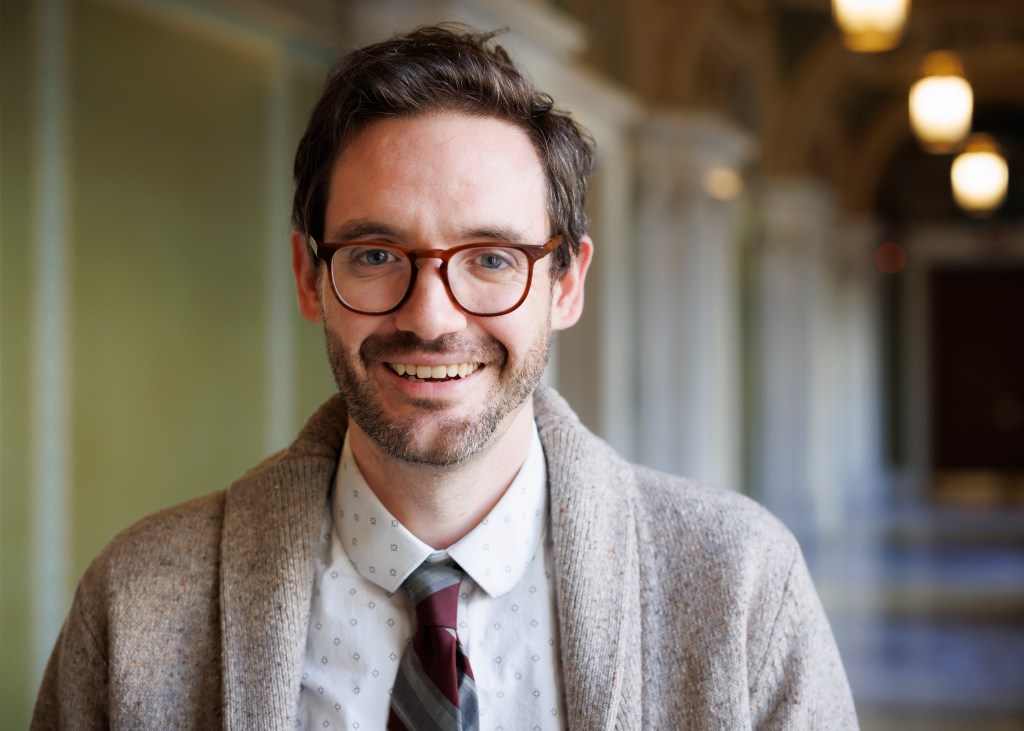
Dr. Trevor Owens is a social scientist, historian, archivist, and research executive working to understand and strengthen the institutions through which knowledge is produced, preserved, and put to use. Across scientific societies, federal agencies, and cultural heritage institutions, he has set research agendas, shaped national strategies for digital infrastructure, and led interdisciplinary research and preservation programs. He brings historical perspective and social science research into organizational strategy, helping communities understand their past, respond to present challenges, and shape their futures.
Owens currently serves as the first Chief Research Officer of the American Institute of Physics. In this role, he has built and leads an integrated research organization spanning social science research, public policy analysis, and the history and culture of the physical sciences, including oversight of the Niels Bohr Library & Archives. He leads AIP’s overall research strategy and annual research agenda, developing the people, partnerships, infrastructure, and funding needed to produce timely research on the forces shaping the physical sciences. Under his leadership, AIP’s research team has expanded its capacity for rapid-response analysis, public policy research, historical scholarship, and research on the scientific workforce and disciplinary cultures, producing evidence that informs scientific societies, higher education leaders, policymakers, and the broader research community.
Owens also leads fundraising strategy for AIP’s research and history programs and has secured more than $1.5 million in external funding from federal agencies and private foundations, including the National Endowment for the Humanities, Institute of Museum and Library Services, Alfred P. Sloan Foundation, and Henry Luce Foundation. These investments support new research, partnerships, and programs designed to strengthen the scientific enterprise and preserve and interpret its history.
He is also a Public Historian in Residence at American University and a faculty member for California’s Rare Book School. He serves in national and international advisory roles with the Roy Rosenzweig Center for History and New Media, Library and Archives Canada, the Council on Library and Information Resources, and the United States Copyright Office.
Across his career, Owens has moved from developing and studying digital tools and communities to shaping national programs and building the institutional infrastructures that sustain knowledge into the future. Previously, as Director of Digital Services at the Library of Congress, he led more than 100 staff and oversaw a portfolio exceeding $20 million annually. He directed digitization, metadata and discovery, digital preservation, web archiving, and a major crowdsourcing program, helping build the infrastructure through which one of the world’s largest cultural heritage institutions manages and provides access to digital collections at scale.
Before joining the Library of Congress, Owens held senior leadership roles at the Institute of Museum and Library Services (IMLS), where he led the National Digital Platform initiative. Under his leadership, IMLS invested more than $30 million in over 100 projects advancing digital infrastructure for libraries and cultural heritage institutions nationwide. He helped shape national strategy for digital library development and coordinated efforts across federal agencies, foundations, and professional communities. Owens began his career at the Roy Rosenzweig Center for History and New Media at George Mason University, where he led outreach and community engagement for Zotero, the open-source research platform.
Owens is the author and coauthor of books on digital preservation, cultural memory, history, and institutional change. His most recent, After Disruption: A Future for Cultural Memory (University of Michigan Press, 2024), examines how cultural institutions can respond to technological and societal change through approaches centered on maintenance, care, and repair. The Theory and Craft of Digital Preservation (Johns Hopkins University Press, 2018) received major awards from the American Library Association and Society of American Archivists and has become a foundational text in the field. His research and writing have appeared in venues including Science Communication, Digital Humanities Quarterly, Physics Today, New Directions in Folklore, American Libraries, Harvard Educational Review, Archival Science, and Curator: The Museum Journal.
His work has been recognized through honors including the University of Wisconsin–Madison Luminary Award (2025), the Frederick G. Kilgour Award for Research in Library and Information Technology (2021), designation as a Library Journal “Mover & Shaker” (2018), and the Society of American Archivists’ Archival Innovator Award. In 2022, he served as a Fulbright Specialist with the National Library of Kosovo, supporting the development of its first national digital collections strategy.
Across his research, writing, and institutional leadership, Owens is interested in how knowledge institutions can become more resilient, responsive, and consequential in a period of rapid technological and social change. His current work increasingly focuses on the research enterprise itself: how scientific communities develop and sustain talent, how disciplinary cultures and institutions evolve, how the historical record of science can inform its future, and how research and evidence can help scientific organizations and policymakers make better decisions about the future of science.
Contacting Me:
The best way to get a hold of me is email (trevor dot john owens at gmail dot com). I am up for commenting on any of the areas that I work in a personal capacity. If you are a journalist on tight deadlines it will likely work best if you can email me a specific set of questions instead of trying to set up a time to talk on the phone.
Interviews and Press:
- Science as Story, Memory as Infrastructure: A Conversation with Trevor Owens, Scholarly Kitchen, 2025
- How Trevor Owens Does History, Contingent Magazine, 2021
- Trevor Owens: Librarian, Historian, Use This, 2021
- Scientists’ Hard Drives, Databases, and Blogs, Interview for the National Library of Medicine, 2018
- Q&A with Trevor Owens, LC Head of Digital Content Management, Library Journal, December, 2017
- Gamification Meets Meaningful Play: Talking Trends with Trevor Owens, Information Today, December, 2016
- Mecha-Archivists Revisited: An Interview with Trevor Owens and Emily Reynolds, BloggERS, 2016
- The National Digital Platform for Libraries: An Interview with Trevor Owens and Emily Reynolds from IMLS, The Signal, 2015
- Owens to head National Digital Platform responsibilities across programs at IMLS, IMLS Press Release, 2015
- Five Questions with Digital Archivist Trevor Owens, Teaching with the Library of Congress, 2014
- Trevor Owens’ First Five. First Five, 2012
- Interview with Trevor Owens, Digital History, 2012
- ScienceOnline2012 – interview with Trevor Owens, Scientific American, 2012
- New Digital Archivist Joins NDIIPP, Library of Congress News Release, 2011
- Zotero: Interview with Trevor Owens, PLOS Blogs, 2009
- Next-Generation Bibliographic Manager : An Interview with Trevor Owens, Innovate: Journal of Online Education, 2008
- How Do You Solve a Problem Like Bibliographies? Zotero! IMLS Project Profile, 2007
Mentions/Quoted in the Press & Media
- Yahoo Answers is shutting down. Why are companies ditching discussion features?, April 2021
- Pop Up Archive Filled a Need for Audio Archiving, and Apple Noticed, Humanities Magazine, Fall 2017
- Why archivists are scrambling to back up the internet By Lauren Fields @lfieldsa Published: Desert News, Feb. 24, 2017
- WhiteSpace Project Could Grow Rural Broadband Access, Library Journal, Jan 2017
- How Adobe Flash, once the face of the web, fell to the brink of obscurity—and why it’s worth saving, Quartz, December 2016
- The Death and Life of Digital Archives: Preserving the present doesn’t always work in the future. Slate, Nov. 4 2015
- IMLS Hires Trevor Owens to Lead National Digital Platform Program, Infodocket, Jan 2015
- Books meet bytes At Radcliffe, thoughts on the future of digital library collections, Harvard Gazette, April 4, 2014
- The Future of Saving the Past Archival Technologies in the Digital Era, Radcliffe Magazine, April 2014
- Another Push for Embargoes Second history organization comes out against requirement that all dissertations be made available online. Inside Higher Education, Dec, 2013
- Embargoes for Dissertations? American Historical Association wants universities to permit blocking of online access to doctoral students’ work for six years, saying such rules will protect new Ph.D.s seeking to publish. Not everyone wants to be protected. Inside Higher Education, July 2013
- Breaking Down Menus Digitally, Dish by Dish, The Chronicle of Higher Education, April 2012
- Research Librarians Consider the Risks and Rewards of Collaboration, The Chronicle of Higher Education, Oct 2011

